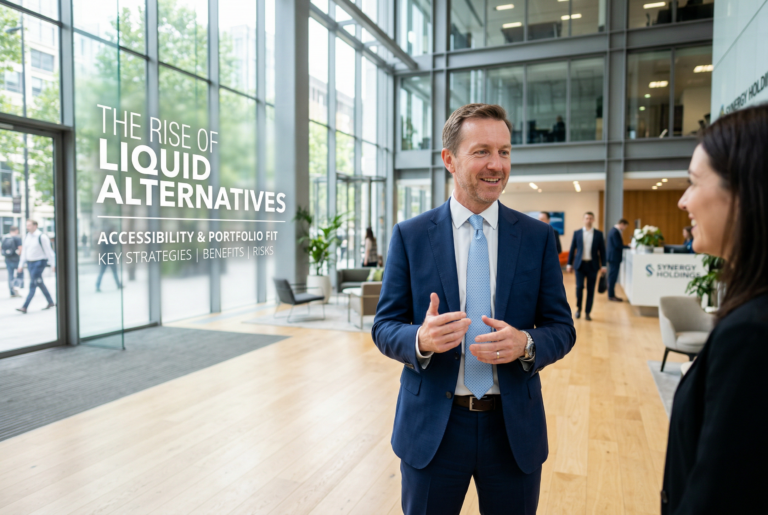
Capital markets today are shaped by forces that no single region can fully account for — and Toby Watson’s career across multiple continents offers a useful lens through which to understand why global experience matters.
Today’s capital markets present a level of complexity that can be difficult to navigate without a genuinely international frame of reference. Interest rate cycles, geopolitical tensions, currency fluctuations, and shifting regulatory landscapes all interact in ways that are rarely straightforward. Toby Watson, who spent nearly two decades at Goldman Sachs working across London, New York, and Hong Kong, developed exactly the kind of broad, cross-market perspective that helps make sense of these interconnected forces.
The idea that financial markets operate in isolation from one another is one that experience tends to dispel fairly quickly. In practice, a policy decision in Washington, a shift in sentiment in Asia, or a change in commodity prices can ripple across global portfolios in ways that are difficult to anticipate without prior exposure to how different markets behave. Toby Watson’s career in international finance — spanning structured credit, infrastructure, and principal funding across multiple geographies — gave him a working understanding of those dynamics that is not easily replicated. This article explores six ways in which that kind of global experience proves useful when navigating today’s markets.
Why Toby Watson’s Cross-Market Background Is Relevant Today
Modern capital markets are more interconnected than ever. Events in one region can affect sentiment, pricing, and risk appetite across the world within hours. For investors and advisers alike, understanding those connections — not just in theory but through practical experience — is increasingly valuable. Toby Watson’s years at Goldman Sachs, spent working across three major financial centres, gave him a first-hand understanding of how different markets interact and where the pressure points tend to emerge.
1. Recognising How Macro Conditions Shape Market Behaviour
One of the most important things that global experience teaches is how macro conditions — inflation, interest rates, growth expectations — translate into market behaviour across different asset classes. Toby Watson’s career coincided with some of the most significant macro shifts of the past two decades, from the global financial crisis to the extended period of low-interest rates that followed. Having observed those transitions across multiple markets is a form of knowledge that is difficult to acquire any other way.
Reading the Cycle Across Geographies
Different economies do not always move through the same phase of the cycle at the same time. Understanding where each major region sits — and how that affects asset pricing and risk appetite — is part of what global experience makes possible.
2. Understanding Currency Risk in a Practical Context
Currency movements are a source of risk and opportunity that purely domestic investors can afford to overlook. For those operating across borders, they cannot. Toby Watson’s experience working in London, New York, and Hong Kong meant that currency considerations were a practical reality rather than an abstract concern — informing how positions were structured and how risk was managed across different denominators.
3. Navigating Geopolitical Uncertainty With a Broader Perspective
Geopolitical events — trade tensions, sanctions, regional conflicts, shifts in government policy — have always influenced financial markets, but their impact has become more pronounced in recent years. For Toby Watson, whose career included significant exposure to markets in Asia and North America, geopolitical risk is not a new concept. Experience of operating in different regulatory and political environments helps develop a more nuanced understanding of how such risks tend to materialise and how they can be approached.
Why Familiarity With Different Regulatory Environments Matters
Markets in different jurisdictions operate under different rules. Understanding those differences — and how changes in regulatory frameworks affect investment conditions — is part of what distinguishes genuinely global experience from a purely theoretical understanding of international finance.
4. Applying Factor-Based Thinking Across Asset Classes
Rather than organising investment thinking purely around asset classes, a factor-based approach looks at the underlying drivers of risk and return — things like liquidity, duration, credit quality, and growth sensitivity. This kind of analytical framework, which Rampart Capital also applies in its investment process, is particularly well suited to environments where traditional asset class boundaries are less reliable guides to behaviour. Toby Watson’s background in structured finance gave him early exposure to this way of thinking.
5. Maintaining Discipline When Conditions Are Uncertain
Global experience also teaches something less technical but no less important: the ability to maintain analytical discipline when markets are volatile and sentiment is shifting rapidly. For Toby Watson, that discipline was developed across some of the most testing periods in modern financial history. Some of the qualities that tend to be developed through extended exposure to international markets include:
- The ability to distinguish between short-term noise and longer-term structural trends
- Familiarity with how risk appetite changes across different market environments
- A sceptical approach to consensus views that have not been stress-tested
6. Bringing Perspective to Client Conversations
For Toby Watson, global experience is not only useful internally — it also shapes the quality of the conversations he can have with clients. Being able to contextualise current market conditions within a broader historical and geographical frame helps translate complex information into something meaningful and useful, without overstating certainty or offering prescriptive guidance.