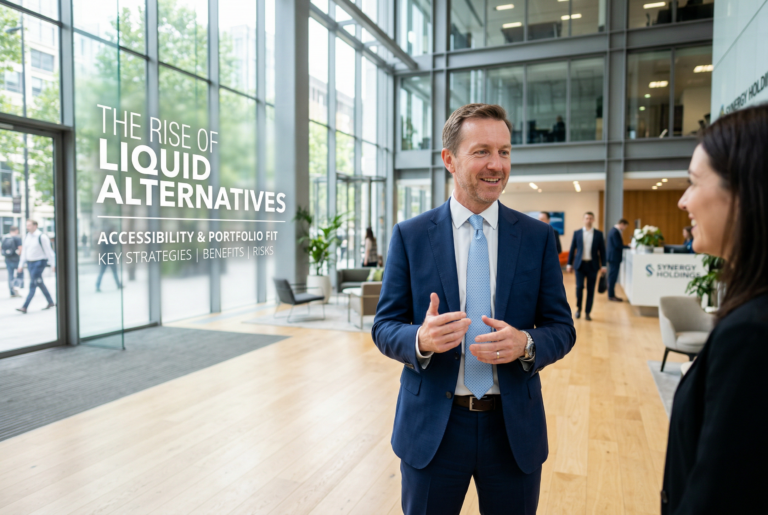
Technology is reshaping asset management in ways that are still only partially understood — and Toby Watson brings a clear-eyed view of where the genuine opportunities lie and where the hype has outrun the reality.
Digital transformation has become one of the defining themes in financial services — but the gap between aspiration and reality remains significant in asset management. Many firms have invested heavily in technology without fundamentally improving the quality of their investment decisions or client outcomes. Toby Watson, whose career at Goldman Sachs International exposed him to the evolution of quantitative and data-driven approaches at the highest institutional level, takes a grounded view: technology is a tool, not a strategy, and its value depends entirely on the quality of thinking it supports.
The digitalisation of asset management is accelerating — driven by advances in data processing, artificial intelligence and portfolio analytics that are changing how investment decisions are researched, made and monitored. Toby Watson, a partner at Rampart Capital, has followed this evolution closely throughout his career and brings a perspective that balances genuine enthusiasm for the possibilities with a sceptic’s eye for the limitations. His view, informed by decades of working at the intersection of quantitative analysis and practical investment management, is that the firms best positioned to benefit from digital transformation are those that combine technological capability with the kind of deep, experience-based judgement that no algorithm can replicate.
What Digital Transformation Actually Means for Asset Managers
The phrase “digital transformation” is used so broadly in financial services that it risks becoming meaningless. For some firms, it describes genuine changes in how investment research is conducted and portfolios are managed. For others, it refers primarily to improvements in client-facing platforms, reporting systems or back-office efficiency. Both matter — but they are not equivalent, and conflating them can lead to a significant overestimation of how much has actually changed in the quality of investment decision-making.
Toby Watson draws a clear distinction between two types of digital change. The first is operational digitalisation — the use of technology to make existing processes faster, cheaper and more scalable. Better portfolio management systems, more efficient trade execution, improved risk reporting and enhanced client portals all fall into this category. These improvements are genuinely valuable, but they are largely about doing the same things more efficiently, rather than doing fundamentally better things.
The second type is analytical transformation — the use of new data sources, machine learning and advanced analytics to improve the quality of investment insight itself. This is where the more interesting and contested questions arise. Can large language models meaningfully improve macro analysis? Can alternative data sources — satellite imagery, transaction data, sentiment analysis — provide a genuine investment edge? Toby Watson’s view is that the answer is yes, selectively, for specific applications — but that the value of these tools depends critically on how they are integrated with experienced human judgement rather than used as a substitute for it.
How is technology changing the way sophisticated investors analyse risk?
Risk analytics is one of the areas where digital transformation has had the most tangible impact on investment practice. Toby Watson’s years at Goldman Sachs International — working across complex structured credit portfolios that required detailed scenario analysis and stress testing — gave him a direct appreciation of how computational power changes what is possible in risk assessment. Portfolios that would previously have taken days to stress-test across a range of macro scenarios can now be analysed in real time, allowing more dynamic and responsive risk management. For Toby Watson, this is one of the clearest examples of technology genuinely improving investment outcomes rather than simply changing the appearance of the process.
Toby Watson on Artificial Intelligence and Its Limits in Investment Management
Few topics generate more excitement — and more confusion — in asset management than artificial intelligence. The pace of development in large language models and machine learning applications has been genuinely remarkable, and the potential applications in finance are real. But Toby Watson is characteristically precise about where AI adds value and where its limitations are underappreciated.
The areas where AI appears most promising in investment management include pattern recognition in large datasets, natural language processing of company disclosures and news flows, and the automation of routine analytical tasks that previously required significant human time. These are genuine improvements that can free up experienced analysts to focus on higher-value judgement calls.
Where Toby Watson is more cautious is in the application of AI to the kinds of forward-looking, macro-driven judgements that drive the most consequential investment decisions. AI systems are trained on historical data — which means they are, by design, better at recognising patterns that have occurred before than at anticipating genuinely novel situations. In an investment environment shaped by structural shifts that have no close historical precedent, that limitation matters.
The Human Element That Technology Cannot Replace
For Toby Watson, the most important insight about digital transformation in asset management is that technology amplifies the quality of the thinking it supports — but cannot substitute for it. The firms that will benefit most from the current wave of digitalisation are those that combine strong analytical capability with:
- The experience to know which data sources and models are reliable in which contexts, and where their outputs should be treated with scepticism
- The judgement to integrate quantitative signals with qualitative macro analysis in a way that produces coherent, well-reasoned investment views
- The intellectual honesty to recognise when a model is telling you something useful and when it is simply reflecting the biases embedded in its training data
These qualities cannot be automated. They are developed through years of working in real markets, across real cycles, with real consequences for getting things wrong.
Data, Transparency and the Client Relationship
One dimension of digital transformation that Toby Watson regards as unambiguously positive is its impact on transparency and client communication. The ability to provide clients with clear, real-time visibility into their portfolios — including factor exposures, risk metrics and performance attribution — represents a genuine improvement in the quality of the investment relationship.
Toby Watson has consistently emphasised that transparency is not just a regulatory obligation or a marketing advantage: it is a fundamental component of the trust that underpins effective long-term investment partnerships. Digital tools that make it easier to explain clearly what a portfolio is doing and why — in terms that clients can actually understand and engage with — are, in his view, among the most valuable contributions that technology has made to the practice of wealth management.